
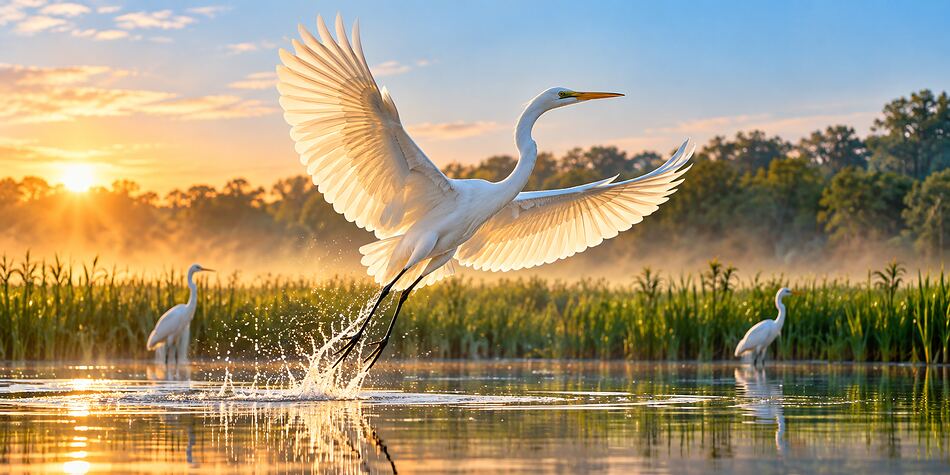
At sunrise a thin mist still lies over the shallows of the northern wetland park. At the end of the boardwalk three great egrets stand in ankle-deep water, dipping now and then to peck at the surface. The park office confirmed this week that they are the first great egrets to arrive this autumn, six days earlier than last year; by last weekend more than 200 herons and egrets were roosting in the park.
Six years ago these 420 hectares of water were reclaimed low ground, with a concrete embankment along the edge and water the colour of mud. The restoration built very little. Most of it was subtraction: 3,800 metres of hard bank came out and gently sloping mudflat went back; the silt was cleared and three side channels upstream and downstream were joined up again; 120,000 reeds, sweet flags and other native water plants were set, and the shoreline was handed back to water and grass.
The change in numbers
- Water quality has risen from worse than Class V, the bottom of the scale, to Class III, and more than 20 kinds of fish and shrimp are common in the shallows.
- The bird list has grown from 34 species to 97, about three in ten of them waders such as herons and sandpipers.
- Each autumn the great egrets and grey herons stay for about four months, and fly north again in spring.
The leader of the volunteer patrol walks the boardwalk at dawn every Saturday and writes down each species and how many she sees; in six years she has filled 11 notebooks. "The first autumn we counted only seven egrets, and we were happy for a week," she says. "If the birds are willing to stay for the winter, there is food in the water and somewhere to hide on the bank."
If you go
The best hours are the two after sunrise and the one before sunset. The park office asks visitors to keep to the boardwalk and out of the mudflats and reeds, to stay at least 50 metres from the birds, not to feed them or fly drones, and to switch off the flash.
This autumn's birdwatching season runs to the end of next month. From 7 to 10 on weekend mornings, volunteers at the hide halfway along the boardwalk offer 20 telescopes and free talks; school groups can book a week ahead with the park office. Next year the office plans a screened hide on the north side of the shallows, so that photographers need not go near the water.
Comments
Sign in to join the conversation.
No comments yet — be the first.