
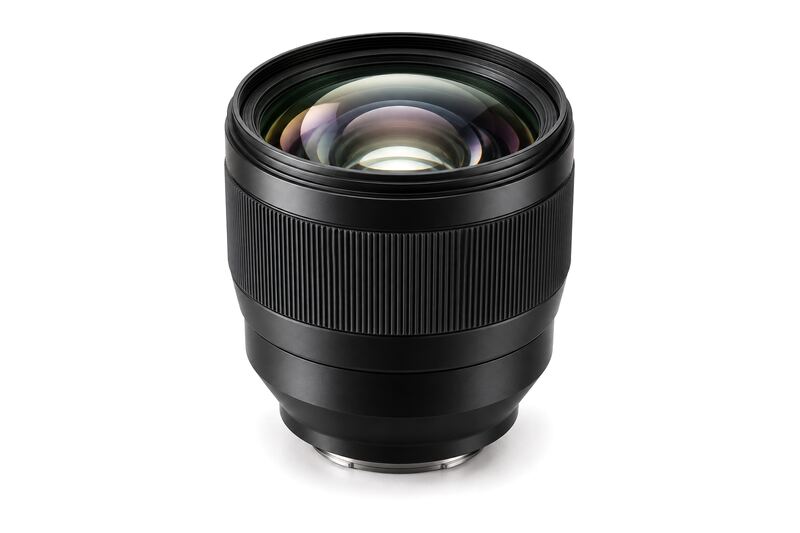
The 50 mm F1.2 is the lens by which the rest of the range is judged. Wide open, the plane of focus is thin enough to hold one eye and no more, and the background melts into broad, soft patches of colour; at f/2 it is a standard lens that is solid from the centre to the edges. It is not cheap and it is not light, but the pictures make it plain where the money went.
The front element fills almost the whole face of the lens. The barrel is stout and black all over, with a broad focus ring round the middle whose firm damping and long travel allow fine manual focusing; on one side are a focus-mode switch and a focus-hold button. There are nine seals, and the front element has a coating that sheds water and grease. It weighs about 980 g and takes 82 mm filters.
The optics are 16 elements in 11 groups. Three aspherical elements hold down spherical aberration and coma at wide apertures, so that lamps in the corners of a night scene stay points and grow no tails. Eleven rounded blades give clean out-of-focus highlights with gentle transitions and no obvious onion rings, and contrast holds up well against the light.
Two linear motors each move a focusing group, and focus is decisive even at f/1.2. With the camera's eye detection, a bride and groom on the move or an actor on stage are caught far more often than with fast lenses of the last generation.
- Portrait and wedding photographers, as a main lens.
- Documentary photographers who often work hand-held in poor light.
- Film-makers who want the look of a shallow depth of field.
Most people will not carry it all day. At a wedding ceremony, in a studio or in a street at night, it delivers pictures other lenses cannot. In the box are the lens, a cylindrical hood, front and rear caps, a soft pouch and a warranty card.
Comments
Sign in to join the conversation.
No comments yet — be the first.