
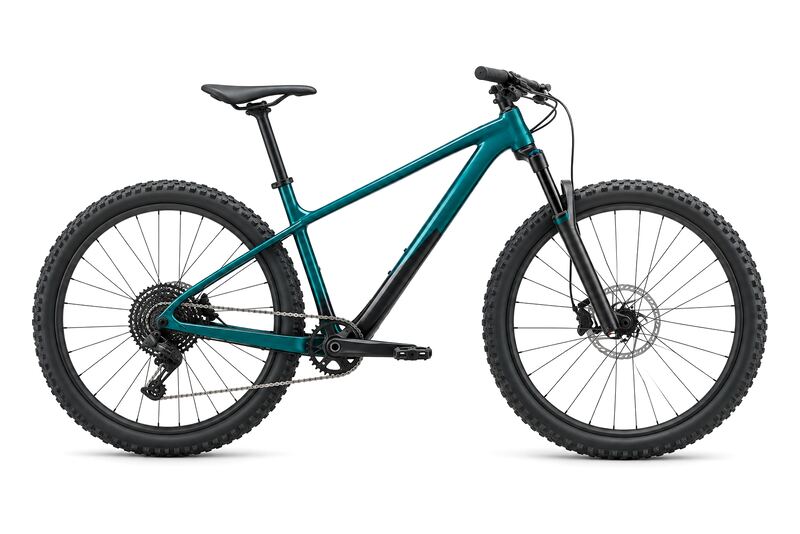
This is a carbon hardtail mountain bike built for forest roads and narrow trails. With no rear suspension the frame is lighter, the pedalling more direct and the upkeep simpler, while an air fork with 120 mm of travel and 29-inch wheels leave enough in hand for loose stony slopes and roots. The paint fades from deep teal at the head tube to black around the bottom bracket, and looks none the worse for a spattering of mud.
A medium frame weighs about 1,150 g and all its cables run inside. The head angle is 67 degrees, slacker than on a traditional cross-country bike; the top tube is longer and the stem has shrunk to 60 mm, which puts the rider's weight further back on a descent and stops the front from wandering at speed. A 75-degree seat angle keeps the front wheel down on a steep seated climb.
- Fork: air sprung, 120 mm of travel, adjustable rebound and a lockout.
- Gears: 1×12, a 32-tooth ring with a 10-51 cassette, with a ratio for long climbs and for sprints on the flat.
- Brakes: hydraulic discs, with a 180 mm rotor at the front and 160 mm at the rear.
- Tyres: 29×2.4 in with a deep tread, on rims 30 mm wide inside that can be converted to tubeless.
Its strength is rolling ground. Uphill it keeps pace with quick companions; downhill, if the line is chosen cleanly, it is not much slower than a short-travel full-suspension bike. Converted to tubeless, the tyres can be run a little softer and grip noticeably better on roots and wet rock. Long flights of stone steps and big drops are not its home ground, and riders who meet them often should look at the full-suspension model in the same range.
It suits beginners who mean to learn off-road technique properly, amateur cross-country racers and forest-road riders who want a light bike for long distances. It comes in small, medium and large, and a medium weighs about 11.4 kg. In the box are a pair of flat pedals, two tubeless valves, a tool kit and a manual.
Comments
Sign in to join the conversation.
No comments yet — be the first.